Why Tip Selection Matters
The soldering tip is the single point where heat transfers from your station to the joint. Its shape determines how much surface area contacts the work, its size affects thermal mass and recovery time, and its plating defines durability under specific conditions.
Using an oversized tip on fine-pitch components can bridge adjacent pads. An undersized tip on large connectors struggles to maintain temperature, resulting in cold joints. The right tip eliminates both problems.
Understanding Tip Shapes
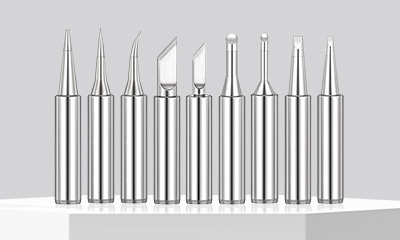
Each tip shape is designed for a specific type of joint geometry. Here is a breakdown of the most common shapes and their ideal applications:
| Tip Shape | Description | Best For |
|---|---|---|
| Conical | Pointed, round cross-section | Fine-pitch SMD, precision work, small pads |
| Chisel | Flat end, rectangular cross-section | General-purpose, through-hole, wire splicing |
| Bevel | Angled flat surface | Drag soldering, moderate thermal transfer |
| Knife | Wide flat blade | Desoldering, cutting, large surface area joints |
Conical tips concentrate heat at a single point, making them suitable for small pads and tight spaces. However, their limited contact area means slower heat transfer on larger joints.
Chisel tips offer the best balance of contact area and precision. The flat face sits flush against pads and component leads, delivering efficient heat transfer for most through-hole and medium-sized SMD work.
Bevel tips provide a larger contact surface than conical tips while maintaining accessibility. They are particularly effective for drag soldering on IC packages.
Knife tips cover a wide area and are primarily used for desoldering or working on large connections.
Sizing: Matching Tip to Joint
The general rule: match the tip width to the pad or joint size. A tip that covers 50-70% of the pad diameter provides optimal heat transfer without risking damage to adjacent areas.
For through-hole components on standard 1.6mm PCBs, a 1.2mm to 2.4mm chisel tip handles most joints. For fine-pitch SMD (0.5mm pitch and below), a 0.2mm to 0.5mm conical tip is appropriate. For large connectors, ground planes, or power components, move up to a 3mm or wider chisel.
Tip length also matters. Shorter tips deliver heat faster but limit access in tight spaces. Longer tips reach deeper but sacrifice some thermal efficiency.
Plating and Durability
Soldering tips typically use an iron-plated construction with a copper core for thermal conductivity. The plating thickness and quality directly affect tip lifespan:
- Standard iron plating: Suitable for general use with tin-lead and lead-free solders. Typical lifespan of 50,000-100,000 joints under normal conditions.
- Heavy-duty plating: Thicker iron layer for high-temperature lead-free soldering and abrasive applications. Extended lifespan in production environments.
- Pre-tinned tips: Come with a layer of solder applied at the factory, ready for immediate use and better initial wetting.
Lead-free soldering at higher temperatures (350-380°C) accelerates tip wear. If your application involves continuous lead-free production, prioritize heavy-duty plated tips.
Compatibility Considerations
Before purchasing, confirm the tip is compatible with your soldering iron model. Key compatibility factors:
- Heater type: Cartridge-style heaters (tip and heater integrated) versus screw-on or push-on tips.
- Diameter and thread: Must match the iron’s collar or heater element.
- Temperature sensing: Some tips include integrated thermocouples for precise temperature control.
If you use a JBC, Hakko, or Weller station, there are compatible tips available from multiple manufacturers. Check the model number against the manufacturer’s compatibility chart.
Quick Selection Guide
| Application | Recommended Tip | Key Factor |
|---|---|---|
| Fine-pitch SMD (0.5mm or less) | Conical, 0.2-0.5mm | Precision access |
| General through-hole | Chisel, 1.2-2.4mm | Heat transfer balance |
| Drag soldering ICs | Bevel, 1.0-2.0mm | Surface contact area |
| Large connectors / ground planes | Chisel, 3mm+ | Thermal mass |
| Lead-free production | Heavy-duty chisel | Plating durability |
| Field repairs (portable iron) | Chisel, 1.6-2.4mm | Versatility |
Making Your Decision
Start by identifying your most common joint type. If you primarily do through-hole assembly, a set of chisel tips in 1.0mm, 1.6mm, and 2.4mm covers most needs. For mixed SMD and through-hole work, add a fine conical tip for precision tasks.
Consider buying tips in sets rather than individually. A well-chosen set of 3-5 tips typically covers 90% of production requirements while reducing the total cost per tip.
Ready to find the right soldering tips for your production line? Browse our full range of Soldering Tips covering JBC, Hakko, and Weller compatible options, or contact us for bulk pricing.